
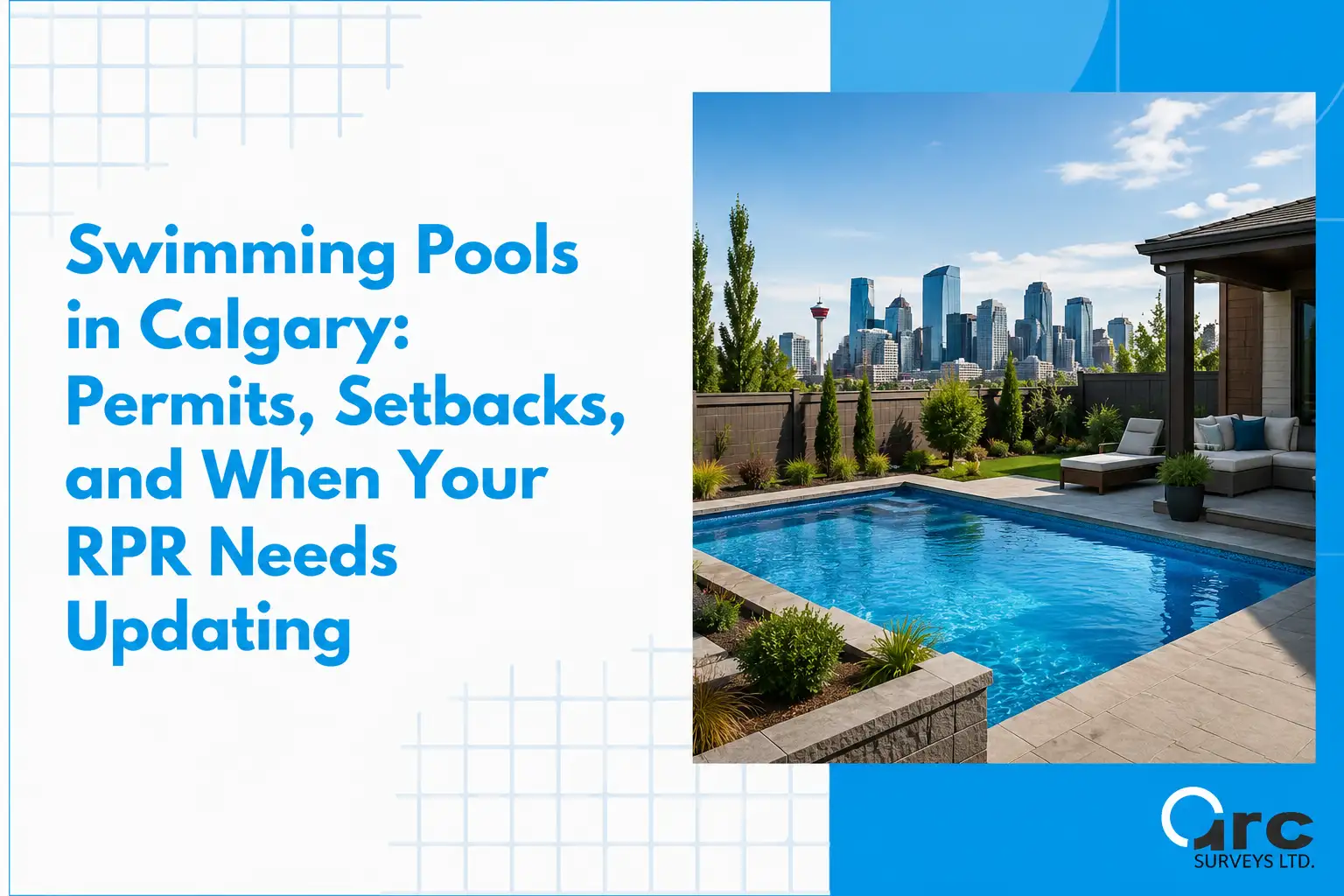
Swimming Pools in Calgary: Permits, Setbacks, and When Your RPR Needs Updating
Everything Calgary homeowners need to know before breaking ground on a backyard pool.
A backyard pool is a significant addition to your property. It changes how you use your outdoor space, increases the complexity of your lot, and in ways that surprise many homeowners, it creates a paper trail of permits, inspections, and survey updates that need to be managed carefully.
This guide covers everything you need to know before you start digging: the permits the City of Calgary requires, the setback rules under the Land Use Bylaw, the fence and enclosure requirements, and the critical question of when your Real Property Report needs to be updated.
Does a Swimming Pool in Calgary Require a Permit?
Yes, and typically more than one. Most homeowners assume they just need a building permit for the pool shell. In practice, a Calgary pool installation commonly requires three separate approvals:
| Permit / Approval | Required? | Notes |
| Building permit | Yes | Required for the pool structure, mechanical room, and associated construction |
| Electrical permit | Yes | All permanently installed swimming pools must be wired by a qualified electrical contractor |
| Development permit | If applicable | Required if the pool or mechanical equipment is closer than 1.2m to a side/rear property line, in a non-standard location, or if the design doesn’t comply with the Land Use Bylaw |
| Gas permit | If applicable | Required if the pool is heated by a gas-fired heater |
| Site plan from surveyor | If applicable | May be required by the City as part of the development permit application to confirm pool location relative to property boundaries |
Starting construction without the required permits can result in stop-work orders, fines, and being required to remove or modify the pool at your own expense. Permits also protect you at resale, an unpermitted pool can trigger a non-compliant RPR that delays or kills a sale.
City of Calgary — Swimming Pools, Hot Tubs and Ponds
Setback Rules: Where Can You Put a Pool in Calgary?
Under Calgary’s Land Use Bylaw 1P2007, swimming pools are classified as accessory structures. Their placement on your lot is governed by specific setback rules:
- Pools must be set back at least 1.2 metres from side and rear property lines
- Pools may not be located in the front setback area: the space between your house and the street, without a development permit
- Pool mechanical equipment must also maintain the 1.2m setback from side and rear property lines
- If your pool or equipment sits closer than 1.2m to any property line, a development permit is required before construction can begin
These setbacks apply to the pool structure itself as well as any associated mechanical equipment. Getting the placement wrong before excavation is an expensive error, the pool is already in the ground before a surveyor or permit inspector catches the problem.
The 1.2m setback sounds generous, but on narrow Calgary lots, particularly in inner-city neighbourhoods, it eliminates more placement options than homeowners expect. Confirming your available pool footprint against your actual property boundaries before you design is essential.
Before you finalize your pool design, it’s worth confirming your property’s exact boundaries. A property line survey gives you the verified measurements you need to position the pool correctly the first time.
Property Line Surveys in Calgary Explained
Pool Fence and Enclosure Requirements in Calgary
This is the area that surprises the most Calgary homeowners. Under the Alberta Building Code, any outdoor pool with a water depth greater than 600mm (approximately 2 feet) must have a compliant safety enclosure installed before the pool is filled with water. This isn’t just a City bylaw, it’s a provincial safety requirement that applies across Alberta.
Fence height
The fence or enclosure must be at least 1.2 metres high, with no gaps or openings greater than 100mm (about 4 inches) that a child could use to climb through. The outside of the fence cannot have horizontal or diagonal elements that could be used as climbing footholds.
Gate requirements
All gates in the pool enclosure must be self-closing, self-latching, and lockable. The latch must be located on the pool side of the gate, out of reach from the exterior, and the gate must open outward, away from the pool area.
Electrical clearances
Any existing overhead wiring must be clear of the pool by at least 5.0 metres vertically and 5.0 metres horizontally. This is a firm electrical safety requirement and cannot be waived. If your yard has overhead wiring that falls within this clearance zone, it must be rerouted or buried before the pool can be installed.
Covered enclosures
If you plan to enclose the pool in a covered structure such as a gazebo or pool house, accessory residential building rules apply. Any covered structure over 10m² in floor area requires a building permit; any covered structure with a finished floor 0.6m or more above grade requires an approved development permit. The same rules that govern decks and accessory structures apply here.
The Deck Permit Process in Calgary
City of Calgary — Pool, Hot Tub and Pond Permit Checklist
Does Installing a Pool Trigger an RPR Update?
This is the question most homeowners don’t think to ask, and the one that can cause problems years down the road.
A Real Property Report shows every permanent structure and improvement on your property in relation to your legal boundaries. A swimming pool, whether in-ground or above-ground and permanently installed, is a permanent improvement that belongs on your RPR.
If you’re selling your home
A seller must provide a current RPR with compliance. If your pool was installed after your last RPR was completed, your existing RPR is no longer current. It won’t show the pool, won’t show the pool fence, and won’t confirm that the pool meets the required 1.2m setbacks. Your lawyer and the buyer’s lawyer will likely both flag this. An updated RPR, and a new compliance review by the City of Calgary, is required before the sale can close cleanly. See Why Real Property Reports Matter: A Guide for Buyers and Sellers for more on what triggers an RPR update.
If you’re refinancing
Lenders may also require a current RPR as part of the mortgage refinancing process. A pool that doesn’t appear on the RPR, or that appears to be in a non-compliant location, creates a problem with the lender’s security review.
If the pool was built close to the property line
If your pool was positioned at or near the 1.2m setback limit, an updated RPR will confirm whether it’s compliant. If the excavation or construction shifted the pool even slightly beyond the setback, that non-compliance will need to be addressed before you can sell or refinance.
The time to update your RPR is right after your pool is complete and compliance-reviewed, not years later when you’re mid-sale and the buyer’s lawyer discovers your property report doesn’t match the backyard. Book your RPR update as part of your pool project close-out.
RPR Updates — When Do You Need One?
Do You Need an RPR to Sell Your Home in Alberta?
What Happens if Your Pool Doesn’t Meet the Setbacks?
If your pool was built too close to the property line, by a contractor who estimated your lot dimensions rather than confirming them with a survey, you have a non-compliant structure. Your options are limited:
- Apply for a development permit (bylaw relaxation) a formal request to permit the non-compliant structure to remain. The process takes approximately two months, sometime more.
- Remove or relocate the pool, rarely practical once it’s been built.
- Negotiate a price reduction at sale to account for the non-compliance, but the buyer’s lawyer will likley still require the issue to be documented and acknowledged.
The cleanest solution is to confirm your property boundaries before the pool goes in, not after. This is exactly what a property line survey or a development permit survey provides, verified measurements you can design from with confidence.
What is a Development Permit Survey in Calgary?
Hot Tubs vs. Swimming Pools: Are the Rules the Same?
Largely yes, the key setback rules (1.2m from side and rear lines, no front setback placement) apply to both swimming pools and hot tubs under Calgary’s Land Use Bylaw. However, there are some practical differences:
- Hot tubs under 10m² that are not elevated on a structure and meet all setback requirements generally don’t require a development permit, though a building permit is still required
- Hot tubs attached to or integrated with a deck may be subject to deck permit rules in addition to the hot tub requirements
- A hot tub installed as a standalone, freestanding unit under 10m² doesn’t require an RPR update; a pool or a hot tub integrated into a permanent deck structure does
Hot Tub Bylaws Within the City of Calgary
Your Pre-Construction Checklist for a Calgary Pool
- Confirm your property boundaries: order a property line survey to establish the exact location of your side and rear property lines before designing the pool layout.
- Check your zoning and Land Use Bylaw: confirm your property is in a zone that permits swimming pools and that your proposed location meets the 1.2m setback requirement.
- Apply for required permits: building permit, electrical permit, and development permit if location requires it. Do not begin excavation without written permit approval.
- Check overhead wiring clearances: ensure any overhead wires are at least 5.0m vertically and horizontally from the pool area.
- Plan for the fence enclosure: the pool enclosure must be in place before the pool is filled. Budget and schedule this as part of the pool project, not as an afterthought.
- Update your RPR after the pool is complete: book your RPR update as part of the project close-out, before you need it for a sale or refinancing.
Key Takeaways
- Calgary swimming pools require a building permit and an electrical permit at minimum, and a development permit if the pool or equipment sits within 1.2m of a property line
- Pools must be set back at least 1.2m from side and rear property lines and cannot be placed in the front setback without a development permit
- A compliant safety fence or enclosure must be installed before the pool is filled, at least 1.2m high with self-closing, self-latching, lockable gates
- Overhead wiring must be clear of the pool area by at least 5.0m vertically and horizontally
- A swimming pool is a permanent improvement that belongs on your RPR, update it after construction is complete
- Confirm your property boundaries before you design the pool layout, not after the excavation is done
Planning a Pool? Get Your Property Boundaries Confirmed First.
Arc Surveys helps Calgary homeowners confirm property boundaries before major projects, and keeps your RPR current after construction is complete. Whether you need a property line survey before you design, a development permit survey for your permit application, or an RPR update to reflect your new pool, our licensed Alberta Land Surveyors have you covered across Calgary and surrounding municipalities.
Get a free quote at ArcSurveys.ca or call 403-277-1272.
Frequently Asked Questions
Do I need a permit to build a pool in Calgary?
Yes. At minimum you need a building permit and an electrical permit. If your pool or mechanical equipment is closer than 1.2m to a side or rear property line, or if you’re placing the pool in a non-standard location, you also need a development permit. Do not begin excavation without written permit approval from the City.
How close to the fence can a pool be in Calgary?
Swimming pools and pool mechanical equipment must be at least 1.2 metres from side and rear property lines under the Land Use Bylaw 1P2007. They cannot be placed in the front setback without a development permit. If your pool sits closer than 1.2m to the property line, you need a development permit, and if one was never obtained, the pool may be non-compliant.
Does my RPR need to be updated after installing a pool?
Yes. A swimming pool is a permanent improvement that must appear on your Real Property Report. If your existing RPR was prepared before the pool was installed, it no longer reflects the current state of your property and will need to be updated before you sell, refinance, or apply for future permits.
What fence is required around a pool in Calgary?
Under Alberta Building Code requirements, any pool with water depth greater than 600mm must have a safety enclosure installed before it’s filled. The fence must be at least 1.2m high, with no climbable horizontal or diagonal elements on the outside, no gaps larger than 100mm, and gates that are self-closing, self-latching, lockable, and open away from the pool. This enclosure must be in place before the pool is filled.
What happens if my pool was built too close to the property line?
If your pool was installed without a survey confirming its setback from the property lines and it turns out to be non-compliant, your options are limited: apply for a development permit (bylaw relaxation), which takes approximately two months and is not guaranteed; remove or modify the pool; or disclose the non-compliance and negotiate with buyers. The far better approach is to confirm your property lines before construction begins.
Is an above-ground pool treated the same as an in-ground pool in Calgary?
The same setback rules (1.2m from side and rear lines, no front setback) apply to both above-ground and in-ground pools. A permanently installed above-ground pool that holds water deeper than 600mm also requires the same safety enclosure. Whether an RPR update is needed depends on whether the structure is permanently installed, if it’s seasonal and fully removable, it generally doesn’t need to appear on the RPR.